INDO-NEPAL FRIENDS

Thursday, December 14, 2006

Negotiation 8. Global Negotiation


Chapter 8. Global Negotiation

Summary

This chapter examines various aspects of a growing field of negotiation that explores the complexities of negotiation across borders. The chapter begins with a discussion of the American negotiating style, from both American and non-American perspectives. While there is a great deal of consistency in perceptions of the negotiation style, it is important to remember that there is also a lot of variability within cultures.
Next, we examined the results of a research of research program by John Graham and his colleagues that compared American negotiators with negotiators from several countries. The process of negotiation differed across countries, however suggesting that here is joke then one way to attain the same negotiation outcome. We then examined some of the actors make cross- border negotiations different. We then disused Sakacyes's description of the environmental factors that Influences global negotiations;
1) Political and legal
2) Internationals economics
3) Foreign governments and bureaucracies
4) Ideology
5) Culture

The chapter concluded with a discussion of how to manage cultural difference when negotiating across. Weiss presents eight different culturally responsible Strategies that negotiators can use with a negotiator from a different culture. Some of these strategies may be used individually, whereas others are used jointly with the other negotiator. However, even those with high familiarity with another culture are faced with a daunting task if they want to modify their strategy completely, when they deal with the other culture.

Negotiation 7. Ethics in Negotiation


Chapter 7. Ethics in Negotiation

Summary
In this chapter we explore the question of whether there are or should be accepted ethical standards for behavior in negotiations. The effective negotiator must recognize must recognize when the question are relevant and what factors must be considered to answer them. Much of what has been written on negotiating behavior has been strongly normative about ethics been has prescribed"shoulds" and "should nots: We do not belief that this approach facilitates the understanding of how negotiators actually decisions about when and where to use specifice tactis. To understand this process better, we approached the study of tactic Choice from a decision-making framework, examining the ethical overtones of these choices. We also briefly discussed the way in which negotiators can respond
To another party who may be using detective technique.
We began by considering several negotiation sasses, showing how ethical question can be critical to the selection of particular strategic and tactical options.
We proposed that negotiators who choose to use an unethical tactics usually decide to do so to increase their negotiating power; power is gained by manipulating the perceived base of accurate information in the negotiation, getting better information about the other party's plan or undermining the other party’s ability
To achieve his objectives.

Leadership10: Leading through the effective external relations


Chapter 10
Leading through the effective external relations
Summary

This chapter has the following objectives
Develop an external relation strategy
Build an external relation strategy
Work with the news media
Handle crisis communication
Any communication activity that touches a company's outside constituencies such as advertising, sales promotions, direct marketing or public relation falls into the
category of external relations. Likewise it also talks about developing an external relations strategy which has the following features
1 clarify the purpose and strategic objectives
2 Identify the major audiences or stakeholders
Creating, refining and testing the major message
4selecting, limiting and coaching spokesperson
5 establishing the most effective media or forum
6 monitoring the results

Like wise working with the media is also essential for which we have to decide when to talked to the media mand preparing for and delivering a media interivew
Finally one has to be able to handle the crisis communication.

Leadership 9:Establishing Leadership through strategic internal communication


Chapter 9
Establishing Leadership through strategic internal communication

This chapter deals with the communication skills and strategy for the internal communication. The first step is to recognize the strategic role of employee
Communication .The communication objective objectives is to
1) To ensure all business units receive the same corporate message that joint decision making is now a priority and,
2) To establish forums.
To accomplish the basic employee communication objectives one have to educate employee in the company vision and strategic goals, motivate employee support for the company's strategy, and encourage higher performance and discretionary effort. Limit misunderstandings and rumors that may damage productivity, align employees Behind the company's performance objectives imposition them to help achieve them. Assessing employee communication effectiveness is also a matter of prime concers. No matters hoe clear, consistent to target the messages, if they are not reaching the intended audiences, they are useless. Establishing effective internal communication also plays a vital role which must have the following features
1 supportive management
2 Targeted message
3 Effective media/forum
4 Well positioned staff
5 Ongoing assessment
Likewise Missions, visions , values and guiding principles make up category of major strategic messages that most organization convey to their employee. First we have to understand the importance of missions and visions. It seems like missions and visions are same but they are infecting different. A mission is a statement of the reason a company exists that is intended primarily for internal use but the vision statement establishes the company's aspirations. Some company has very much sugar coated mission and vision but they never keep track of them. Hence, we have to make sure the mission and vision are effective. Mission and vision could be one of them
CEO /leader developed
Leader-senior team visioning
Bottom up visioning

We might take the following steps in a leader-led, interactive, employee-involved approach to building a mission and vision.
1) Create initial draft
2) Clarify the meaning
3) Tell the world in 25 weeds or less what you are and what your want to become to
Develop the strategic objectives to make the vision specific and actionable
5) Hold cascading meeting with employees to test the mission and the vision
The last section of the chapter deals with the designing and implementing effective change communication and the scope of the change communication program and the
Structuring a communication program to major change

Leadership 8:Building and leading high -Performing Teams


Chapter 8
Building and leading high -Performing Teams
Summary

This chapter deals with building and leading high- performing teams. It is obvious that one individual person can do everything in an organization hence for Most of the purposes we need to build team but team always should be effective. Before deciding to use teams across the company we have to look the culture And compensation structure of the company. The team should be build in such a way that it should be effective and it will be the efficient way to perform the task solves the problem, generate the new ideas or generally move our company forward in some way. While forming the team one should have to consider that the team shouldn’t have duplication of same characters. The team will generally considered as the perfect if it has complementary skills (problem- solving, technical/functional, interpersonal), Accountability (mutual, individual and small number of people), commitment (specific goals, common approach, meaningful purpose)
It further Deals with establishing the necessary team work process which includes the initial ways to start the team operation. So on creating Team Charter may Includes
1 Project purpose
2 Team member Roles and Responsibilities
3Team Ground Rules

Likewise having a communication protocol is also vary essential because of involvement of various people there should be certain way how to reach the people Action and work plan is equally important for the team preparation as the problem might be very complicated it helps the team to guide the proper path. After that once the team is formed and it is gone into axon the delivery of results also very important part of group formation .And when the group moved ahead every Member of team to get a lot of opportunity to learn form the experience which can also be taken one of the aspects of team benefit.
The last section of the chapter describes the way how to manage the people side of team and it could be position and responsibilities, team experiences, expectations, Personality, cultural differences.

Leadership:7 Leading Productive Management Meeting


Chapter 7
Leading Productive Management Meeting
Summary

This chapter deals with the ways to deal with leading productive meeting and its various aspects. The main objective of this chapter is given below
*Decide when s meeting is the best forum
*Compare essential meeting planning
*Conduct a productive meeting
*Manage conflict
*Ensure meetings lead to action

Meeting is the only place where one can express the current problem of an organization, share information, develop and implement new methodology and convey the new methodology and instruction. Before conducting the meeting one should have to essential planning which may include its purpose and expected outcomes, agendas, attend ends .Best settings and timing and essential of the meeting.One can conduct productive meeting only by deciding the decision making approach, clarifying leader and attendees roles and responsibilities because early definition of roles will help us avoiding confusion. No matters how big or small or complicated the meeting is we have to establish a meeting ground rules. The most part of this Chapter deals with the ways of common problem solving approaches which might be brainstroming: the goal of brainstorming is to generate and exhaustive list of ideas quickly.
Ranking or rating: Ranking or rating is performed with an existing set of ides. Perhaps generated from a brainstorming session.
Setting by category of Logical groups: Sorting by category or logical groups a beginning list although you might add items as they occur in the discussion as well.
Edward de Bono's Six Thinking Hats: This is one of the problems solving approach which main motto is to encourage open and complete thinking about a problem by separating ego. This approach is which he says a parallel thinking approach?
Opposite Analysis: Opposition analysis requires the group to look at both sides of an issue.
Decision Tree: This helps to break the problem into its parts .This is particular important when the problem is complex.
Form/to Analysis: this is particularly useful in diagnosing change situations.
Force-Field Analysis: This includes describing the current problem, end state and its driving force and ways to find its solution
Matrix: A matrix allows a group to evaluate or diagnose problems and the difficulties of making change and can help a group decide on an approach. It consists
Of four boxes with each axis assigned an evaluative label.
Framework: This is a shorthand process for discussion and it helps us to simplify the complex problem
The last section of the problem deals with managing meeting problem m and conflict which describes us the way to handle the specific meeting problem and managing
Meeting conflict and dealing with the cultural differences.

Thursday, December 07, 2006

Leadership 6 Developing Emotional Intelligence and Cultural Literacy to Strengthen Leadership Communication

Communication Chapter 6
Developing EQ and cultural literacy to strengthen leadership communications

Leader needs socialized skills to understand and grasp the cultural diversity. There is a distinction between the process of “Leadership” and the socially constructed role of “leader”. Without these skills the leader cannot model and complete the framework and manage perfectly. The competency framework approach gains recognition in leadership development and are put forth under the name “Emotional Intelligence” .Emotional intelligence is a key legal and ethical responsibility to indicate the kind of skills, behavior and values of yours and other individuals. The leader’s emotional intelligence determines the changing nature of work and society as well as new approaches that encourage a more collective and emergent view of culture and performance within organization.Here the success of individual counts to the beginning of emotional intelligence.


For leadership communication the emotional intelligence and cultural literacy there are come constructs such as personality, alexithymia (difficulty in feeling and distinguishing emotions) and leadership. Significant leadership does exist between culture and emotional intelligence. Emotional intelligence and socialized skills include:

Leadership which aspires.
Motivation
Employee Effectiveness.
Generating awareness of organization goals.
Positive interactions.

Firstly we seek towards emotional intelligence with workplace settings. It can be related to increased success by categorizing every individual position and there by enhancing the capability of a person offering training with emotional intelligent work forces. Applying the intelligence construct to the public service also come into existence to ease the effectiveness of their work.

The overall behavior of a person depends on his or her dressing style, body language, understanding, emphasizing, listening, framing, and expressing the issue all count to communication. Emotional intelligence is defined as the ability to understand your own and others emotions and to use the emotions to think more effectively. Others include Facial expressions, verbal and non-verbal forms of communication. Even though non-verbal communication is useful it has its own drawbacks and a leader must avoid them and make use of verbal communication skills.
Emotional intelligence is branched into:

Perceiving Emotions – Ability to perceive in oneself and others.
Facilitating thought – Ability to generate, use and feel emotion.
Understanding – As to how emotions combine and progress through transitions and appreciate such emotional meanings.
Managing – To promote personal understanding and growth.
Levels of EQ can be scaled as:

Intrapersonal: Self regard, Assertiveness, Emotional Self-Awareness.
Interpersonal: Empathy, Social responsibility.
Adaptability: Flexibility, Problem solving.
Stress management: Stress tolerance, Impulse control.
General mood: Optimism, Happiness.


Knowing the values, strengths and limits of individuals are assessed with the cultural diversity. Focused information on which competencies they need to improve so that they can meet their career goals to globally expand the organization are to be modeled.

Instead of getting into conclusions if the emotions are emphasized by your creative style coupled with the ability to generate creative responses to business problems yourself and through others. With empathy and social skills a leader can recognize and understand your feelings and emotions and manage his/her impact on other people.

Leadership 5 Using graphics and power point for a leadership edge

Chapter 5
Topic: Using Graphics and Power point for the Leadership edge.


Leaders know that graphics has met the needs of a well trained and progressive individual. Graphics enhance the level of imagination of an individual .Graphics improve the skillset and creativity developed to transform the materials from complicated amount of data to simple pictorial representations which can be easily perceived. Graphic communication used in industries and organizations have reviewed, improved and endorsed this definition.

Leaders use the visuals of their creativity, development of their products or their oriented tasks. Instead of incorporating words they make use of pictorial images to convey the information and ideas. Graphic communication not only facilitates easy learning or presenting but also drags the attention of the audience.

Graphic taken should be meaningful and purposeful. The contents of the given presentation should either be represented in the form of figures, bar graphs or block diagrams. Graphic can be utilized and the patterns should be represented as follows:

Outline of the Task.
Main ideas of the presentation.
Detailed information represented in graphical format
Imaging technology added to the ideas
Graphical arts to emphasize shape, form and pattern to specify the coding of the system and a medium to drag people’s attention.

Considering the data sheets and adding them to the presentation we first need a most common and expected form of presentation and it can be done with pre-installed software such as Microsoft PowerPoint, Excel. The visual literacy on the whole can be shown even between the past results and the present data. An often cited study is used to refute the idea that visual communication must be implemented to make the tasks easier to understand.

Visual communication advantages include:

A set of the basic data format can be combined and represented completely with images in an order.
Images or graphics are completed by captioning so that the audience can understand easily.
Making the slides very precise and simpler.
The accuracy of communication is increased in visuals that are accompanied by simple text.

Choosing a format, font size for headings and sub-headings and the colors used also makes the presentation interesting.

Leadership 4. Developing and Delivering Leadership Presentations

CHAPTER 4


DEVELOPING AND DELIVERING LEADERSHIP PRESENTATIONS

Behavior of an individual is observed and categorized by the “styles of leadership”. Leaders are exceptional people born with innate qualities, destined to lead the skills of a leader are recognized while interacting with people, participative approach and effective leadership style to fit particular circumstances. Leadership as a process that is diffuse throughout an organization apart from a formally designated ‘leader’. Leaders are recognized and rewarded in return for their commitment, their way of communicating with people, administrative ability, fluent in speaking and being diplomatic and tactful.


When considering an oriented task, you need to emphasize, plan, exercise a relatively high level of imagination, organizing and overall presenting your creative skills to achieve the objectives and utilize their conditions of modern industrial life. After emphasizing the expenditure of your physical and mental effort in work naturally gives rise to your actual oriented task. Task is effectively used for participative management.


The participative management or the presentation includes brief sketch, roles clearly communicated and close supervision of the performed task; task structuring, quality and rate of work, practicing or implementing. Then the presentation involves one practicing or implementing. Then the presentation involves one way communication sometimes if task is allocated with group then there will be multiple participation mainly focused on directing his or her behavior, today language, varying degrees of maturity or confident levels depending on the specific task, rate of speech reward peoples attention is determined as to how well they listen and perceive right from the beginning and from their support and encouragement.

Finally, your image determines the overall participation. A lesson should have the power, skill, through expression and self confidence to withstand the situations in all aspects. The capacity to “get it done” and attracting attention is a must. Collecting admirers with your presentation. The best method is to make himself comfortable and strengthen his skills.

Leadership 3. Using Language to Achieve a Leadership Purpose


Chapter 3. Using Language to Achieve a Leadership Purpose

This chapter basically talks about achieving positive ethos through tone and style and teaches us how to communicate clearly and concisely. Moreover this chapter also gives us idea about proper using of business language and teaching different editing techniques.
To project a confident tone when we speak and when we write we need to possess confidence not only in your knowledge on the subject but also in our ability in capture the content in the right words used in the right way. There should be always positive ethos scattering around the document prepared by the managers and the words spoken by the mangers. The same message whatever bad or good can be delivered in ether good ways or bad ways that all depend upon the way how he prepared the documents and the way he use the words.
The second important thing for preparing documents is to make the documents as far as concise as possible without missing the main points. Sometimes in the hope of making the documents concise the leaders will go to miss some important points of which we have to be cearful. There are several ways to make the document concise and some of them are like follows
1) Avoiding the overuse of the passive voice – bringing the actor always in the first of the sentence
2) Avoiding expletives, such as “ There is “ or “It is “ – watch for the “ It is –“ construction in particular
3) Avoiding the use of prepositional idioms
4) Avoiding the overuse of prepositional pronouns “WHO”, “Which”, and “that”
5) Avoiding the repetition of words and ideas
6) Not overusing descriptive words, particularly adverbs,
7) Avoiding weasel words, ambiguous noncommittal words
8) Being aware of jargon
9) Using proper punctuation, commas , question’s mark ,semi-colons, apostrophes, parentheses
10) Being careful with Mr., Miss mad man

At last but not the least leaders always should use efficient and effective editing techniques for correction though there is a lot of correction tools available in the market.

Leadership 2. Creating Leadership Documents


Chapter 2. Creating Leadership Documents

Chapter II mainly discuss about creating leadership documents. Sometimes documents crated by leaders can cause a lot of problems and sometimes it even comes associating with the prestige and image of the organization. Hence, documentation should be handled properly and with maximum care.

In according to the type of message delivered and previous chain of communication practiced in the organization, selecting the most effective communication medium plays a vital role while making documents. The type of medium might be text message, emails, memo, letters, discussions, outlines, chart pack or dect reports.

Creating the document alone or in collaboration with a team or other group having some plans will help you to be more productive. Creating individual documents means involving the same person from the initial stage to the final stage by oneself. Thus, we can have more control over the entire documentation but sometimes due to lack of expertise the may not be properly organized. When we prepare the documents in team we divide our workloads and responsibilities in between team member in accordance to their area of specialization. The documents prepared in a team uses one of the two ways to divide the tasks.

i. One person in the team does all of the writing with the others providing the contents to the scribe.
ii. The team divides the writing among the team members according to the sections for they have provided most of the contents. Hence, it could be the single scribe approach, the multiple control approach.

Further, both of them have advantages and disadvantages as well. There should be always some controlling version for both to keep the version straight, the team should decide together when drafts are due, who is to receive them and in what order they are to be circulated through the team.

After that the documents contents should be organized properly. Many business documents exhibits form memos to letter. The exhibit could be placement or labels. Moreover, the business documents usually includes information that you have obtained from primary research (that you conduct directly through surveys, interviews or direction observations) or secondary research (which is research using published materials in book and in the way). Both type of research should be handled properly to make a document stronger and effective.

While creating the business documents, consideration should be given for effective formatting, layouts, alignments, line spacing, proper heading, proper font size and type.

Leadership 1. Developing Leadership Communication Strategy


Chapter 1. Developing Leadership Communication Strategy

Summary:

This chapter mostly focuses on developing leadership communication strategy vicinity. The first thing we should have to be clear while building communication strategy is establishing a clear purpose. The purpose could be one of the three to inform i.e. transferring facts, data or information to someone.
To persuade; convincing someone to do something
To instruct; instructing someone in process.

Once we determine our specific purpose before presenting to someone, we have to analyze it. The tools for analyze could be one of the following

1.brainstorming: - conducting an interval discussion with ourselves and jotting down the subject and any ideas related to it as they occur to us within our concern for merit, order or login.
2. Idea Mapping: - It is similar to brainstorming but in the idea mapping instead of a list of ideas, we create a visual representation of our ideas.
3. The journalists Questions: It is the way to ask questions by journalists to get the actual picture of the subject matter that includes questions like who? What? Why? Where? How?
4. The Decision Tree:

It is the way to break a topic into its parts so that you can see how the subtopics relate & whether we right support and enough support.

Determining communication strategy is the 2nd essential step in communication strategy. It helps us to determine the communication objectives. It will consider all the angles and anticipate any issues that might emerge to interfere with communicating the message we want to deliver.

Before presenting our message we have to read the mind and physie of audience because the audience might be hostile, audience might be more experienced than you or they might simply come here to hear your address.
After getting the complete figure of audience we have to organize the written and oral communication effectively. There are several devices for doing so.

Deduction
Induction
Chronological
Cause effect
Comparison /contrast
Problem /Solution
Spatial

Further, we can present the document in couple of ways and one of them is using pyramid principle where we begin with our main argument and then we establish a dialogue that supports each part of the argument with specifies that answer the questions “Why”, “What”, or “How”.
Another technique is crating a storyboard, which is particularly useful while we work in a team and prepare presentation in a group.

Negotiation 6. Finding and Using Negotiation Leverage


Chapter 6
Finding and Using Negotiation Leverage

In this chapter, we focus on leverage in negotiation. By leverage negotiators ca use to give them an advantage or increase the probability achieving their objectives. All negotiators want leverage they want to know what they can do to put pressure on the other party, to persue the other to see it their way, get other to give them what they want,
Leverage is often used synonymously with power. Most negotiators believe that power is important in negotiation, because it gives one negotiator an advatage over the other party. Negotiators who have this advantage usually want to use it to secure greater share of the outcomes or achieve their preferred solution,
This chapter defines power in various perspectives and one of them is to have an ability to bring about outcomes they desire or the ability to get things done the way them to be done. Further, we know that power is based on various factors information and expertise, control over resources, One’s positions.
We then turned to examine a very large number of influence (leverage) tools that one could use in negotiation. These tools were considered in two broad categories: influence that occurs through the central route to persuasion, and influence that occurs through the peripheral route to persuasion
In the last major section of the chapter, we considered how the receiver the target of influence either can shape and direct what the sender is communicating or can intellectually resist the persuasive effects of the message. Effective negotiations are skilled not only at crafting persuasive messages but also at playing the role of skilled “consumers” of the messages that others direct their way.

Negotiation 5. Perception, Cognition, and Communication


Chapter 5
Perception, Cognition, and Communication
Summary
This chapter discuss about those fundamental processes that govern the individuals conduct and interpret the interaction the take place in a negotiation and is perception l, cognition and communication. Negotiators approach each negotiation guided by their perception of past situation and current attitudes ad behaviors. Perception is the process by which individual connect to their enivironment. In this chapter we examined how negotiators make sense of negotiation and the role that communication processes play in negotiation processes and outcomes.
The first portion of the chapter discussed perception and negotiation, beginning with a brief overview of the perceptual process. This mainly discussed how fraying influences perceptions in negotiation and how reframing and issue development both change negotiator perceptions during negotiations. The chapter then reviewed the research findings on important cognitive missed in negotiation and considered ways to manage misperceptions and cognitive biased in negotiation
The chapter then shifted to a discussion of what is communicated during negotiation. Rather than simply being an exchange of preferences about solutions negotiations can cover a wide-ranging number of topics in n environment where each party is trying to influence the other. This was followed by an exploration of two issues related to how people communicate in negotiation: the use of language and the selection of a communication channel.
In a final three sections do the chapter we considered hoe to improve communication in negotiation, mood and emotion in negotiation and special communication considerations at the close of negotiation.

Negotiation 4. Strategy and Tactics of Integrative Negotiation


Chapter 4
Strategy and Tactics of Integrative Negotiation
Summary
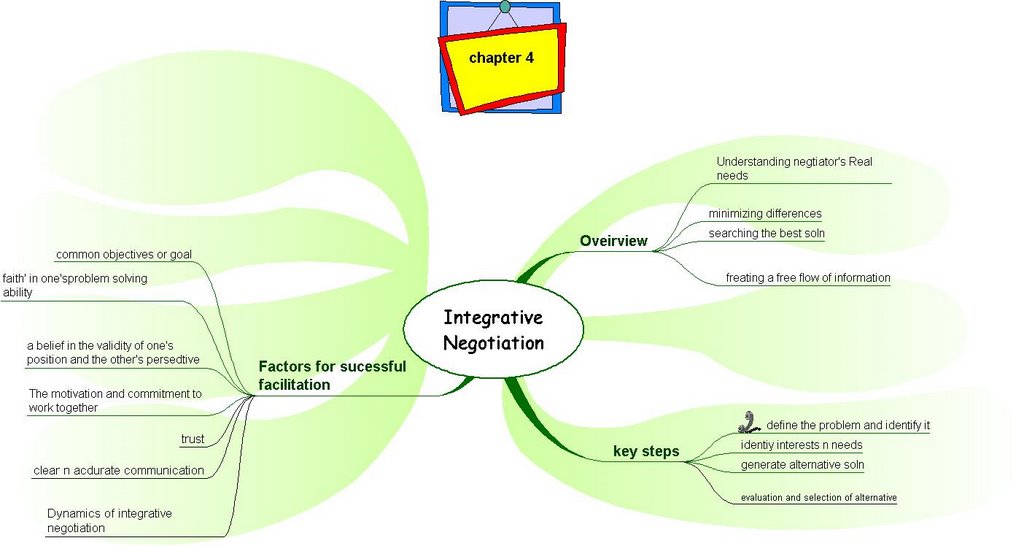
In this chapter we basically deal with integrative negotiation and it is different from other kind of negotiation. First the goal of the negotiation should be addressed properly otherwise we can never reach the solution. This type of negotiation needs to create a free flow of information and we have to clearly the negotiator’s real needs and objectives. The primary purpose of this type if negotiation is to build the foundation where there will be more similarities in between two and more parties focusing their goal and objectives. It is the process of defining these goals and engaging is a set of procedures that permit both sides to maximize their objectives.
The chapter begins with an overview of the integrative negotiation process a high level of concern for both sides achieving their own objectives proper a collaborative problem-solving approach. Negotiators frequently fail at integrative negotiation because they fail to perceive the integrative potential of the negotiation problem. However, breakdowns also occur due to distributive assumptions about negotiation problem, the mixed motive nature of the issues or the negotiators previous relationship with each other. A successful integrative negotiation requires several processes. First the party’s needs must understand each other/s true needs and objectives. Second, they must focus on their similarities, emphasizing their commonalities rather than their differences. Third, they must focus on their similarities, emphasizing their differences. Finally, they must engage in a search for solution that meets the goals of both sides. This is a very different set processed from those in distributive bargaining.
Identifying and defining the problem, identifying interests and needs, generating alternative solution, and evaluating and selecting alternatives are the four key steps in the integrative negotiation process. This chapter stressed that successful integrative negotiation can occur if the parties are predisposed to finding a mutually acceptable joint solution. Many other factors contribute to a predisposition toward problem solving and a willingness to work together to find the best solution. For effective negotiation there should be common objectives and goals. Three types of goals – common, shard and joint may facilitate the development of integrative agreements. There should be always faith in One’s problem solving ability and Parties who believe they can work together usually are able to do so. It also emphasize in a having a belief in the validity of One’s own position and the other’s perspective. The purpose of integrative negotiation is not to question or challenge the other’s viewpoint, but to incorporate it into the definition of the problem and to attempt to it as the parties search for mutually acceptable alternatives. For integrative negotiation to succeed the parties must be motivated to collaborate rather than to compete. Both parties who are in the negotiation always should have at least a minimum level of trust because without that we can never move ahead though having trust means being close to the solution. The most important precondition for the integrative negotiation is clear and accurate communication.

Negotiation 3. Strategy and Tactics of Distributive Bargaining


Chapter 3
Strategy and Tactics of Distributive Bargaining

This chapter basically describes the basic structure of distributive or competitive bargaining strategies, which is vital in negotiation. Further, it goes in detail about the ways of tactics used in distributive bargaining. Distributive bargaining begins with setting our own opening , target and resistance points. After that the major concerns for us is to find the starting points of the other party, which is not an easy task. Likewise the resistance point of the other party is very vital to find out for us but it is late unknown until the negotiation reached the last stage and this is because they always tried to hide it as they think they are precious to them. The spread between the resistance points defines the bargaining range. If we are able to predict the negotiation is considered to be moving in the direction of the positive movement otherwise successful negotiation can never be possible.
Negotiation can never have only one item hence it has a set of items called the bargaining mix. Each item in a bargaining mix can have opening , target and resistance points. The bargaining mix mainly provides opportunities for bundling issues together, trading off across issues or displaying mutually concessionary behavior .
To achieve the successful resolution the structure of distributive bargaining should be properly studied or examined . The motives behind this study is to influence the other party’s belief about whist is possible and to learn as much as possible about the other party’s position, particularly about he resistance points. The negotiator’s basic goal is to reach a final settlement as close to the other party’s resistance point as possible. The negotiators should have to first study the opposition’s standing points and should have convince them for the settle ling down from their standing points make their own stand more realistic and conforming too.
Distributive bargaining is basically a conflict situation wherein parties seek their own advantage in part through concealing information , attempt ion to mislead or using manipulative actions. When the negotiators became calm and realistic, never being hostile this objective can be achieved easily. Negotiotion always attempt to resolve a conflict without force without fighting. At last but not the least at the end of the negotiation both the parties should have to feel that the result that they are getting is most probably the best result they can get ever in this situation.

Negotiation 2. Negotiation: Strateging, Framing, and Planning


chapter 2
Negotiation : Strategizing, framing and planning

This chapter basically explains the key factors that a negotiation needs to know and understand to successfully plan for negotiation . The first step in developing and executing a negotiation strategy is to determine one’s goals. Negotiation differs in the goals they select. Goals can be specific ( to achieve a particular outcome) or they can be more general ( to pierce a broader set of interests)
Goals are of two kinds one is tangible and the other is intangible. Tangible goals could be a particular rate of source of financial outcome and intangible goals might be winning , beating the other or defending a principle.
Strategy is to achieve one’s goals of the overall plan though there is miner difference between strategy and tactics. Hence they seem to be indistinct but one of the major differences is that of scale perspective or immediacy. Tactics are short –term, adaptive while that of strategy are structured directed and driven by strategy consideration. Planning is an integral part of the strategy process the action component
Goals can be achieved by defining the frames. Framing is about focusing , shaping and organizing the world around us . It is about making sense of a complex reality and defining it in terms that are meaningful to us. Frame is critical to understand strategy. Both parties have frames and they are controllable in some extent. There are several major strategies that can be used in negotiation and it all depends upon the type of the objective u hold. Objective could be collaborative and competitive
Negotiators differ in ho3w they “frame ‘ the problem , issue or conflict. There may be other ways to define it that may make the problem more or less amenable to negotiation and resolution. The other party may not be defining it in the same way , which may contribute to the ease or difficulty with which the parties can communicate about the problem with each other.
Negotiation tends to evolve over time according to certain predictable sequences. These sequences comprise the different stages comprised the different stages or phased of a negotiation l the models indicate that negotiation is not random process but has some predictable elements to it overtime.
There could be number of ways to do planning and it only differs form one to another in some set of sequences and negotiators should be aware of all the possible probability of consequences that may encounter during the process of negotiation.

Negotiation 1. The Nature Of Negotiation


Chapter 1. The Nature Of Negotiation

People are always in negotiation and the structure and processes of negotiation are fundamentally the same at the personal level as they are at the diplomatic and corporate levels. Negotiations occurs for one of two reasons
1) To create something new that neither party could do on his or her own or
2) To resolve a problem or dispute between the parties.
This chapter basically comes across the words bargaining and negotiations often interchangeably. Negotiation is a more formal process that occurs when parties are trying to find a mutually acceptable solution to a complex conflict.
Characteristics of a negotiation situation are as follows
1) There are two and more parties
2) There is a conflict of interest between two or more parties
3) The parties tries to negotiate because they want to influence each other
4) In between two parties or more one of the party might be ready for agreement rather than to fight openly have one side capitulate permanently break off contact or take their dispute to a higher authority to resolve it.
5) In negotiation there is always give and take
6) Successful negotiation involves the management of intangibles as well as the resolving of tangibles
The situation of mutual dependency is called interdependence. In negotiation both parities need each other. Interdependent relations are complex and have their own special challenge. Hence, managing and dealing with those option s can be difficult however because of the complexity of the interdependent relationship Interdependent relationships are characterized by interlocking goals. The parties need other to accomplish their goals. Interdependance may be “ win-loose” or :”win-win” situation where in the case the 0nly one party gains the more the other party loose and in the last case both the party can be in the benefit.
The mutual adjustment continues throughout the negotiation as both parties’ acts to influence the other. Interdependent relationships those in which people are mutually dependent are complex. Problem solving is essentially a process of specifying the elements of a desired outcome examining the components available to produce the outcomes. IN every negotiation there might be dilemma of honesty and dilemma of trust may be happen.
Identifying systematic biases in negotiators initial perception of the nature of the interdependence between the negotiating parties is the key thing. One of he main source of value creation is contained tint he differences that exist between negotioators. There are many types of differences
Differences in interprets
Differences in opinions
Differences in risk aversion
Differences in time preference

The other potential consequence of inter-dependent relationship is conflict .Conflict can occur when the two parties working toward the same goal and generally
Want the same outcomes
Conflict can be one of the following
1 interpersonal or
2-intra personal
3intra group
4 inter-groups

I t is not proper to judge conflict as bad thing because a lot of improvements can be done because of conflict.
Conflict management is the way that the parties themselves cab manage conflict. Two dimensional framework also called dual concerns mod
el best defines the conflict management process There are five major strategies for conflict management have been commonly identifies in dual concern model
1) Contending
2) Yielding
3) Inaction
4) Problem solving
5) Compromising